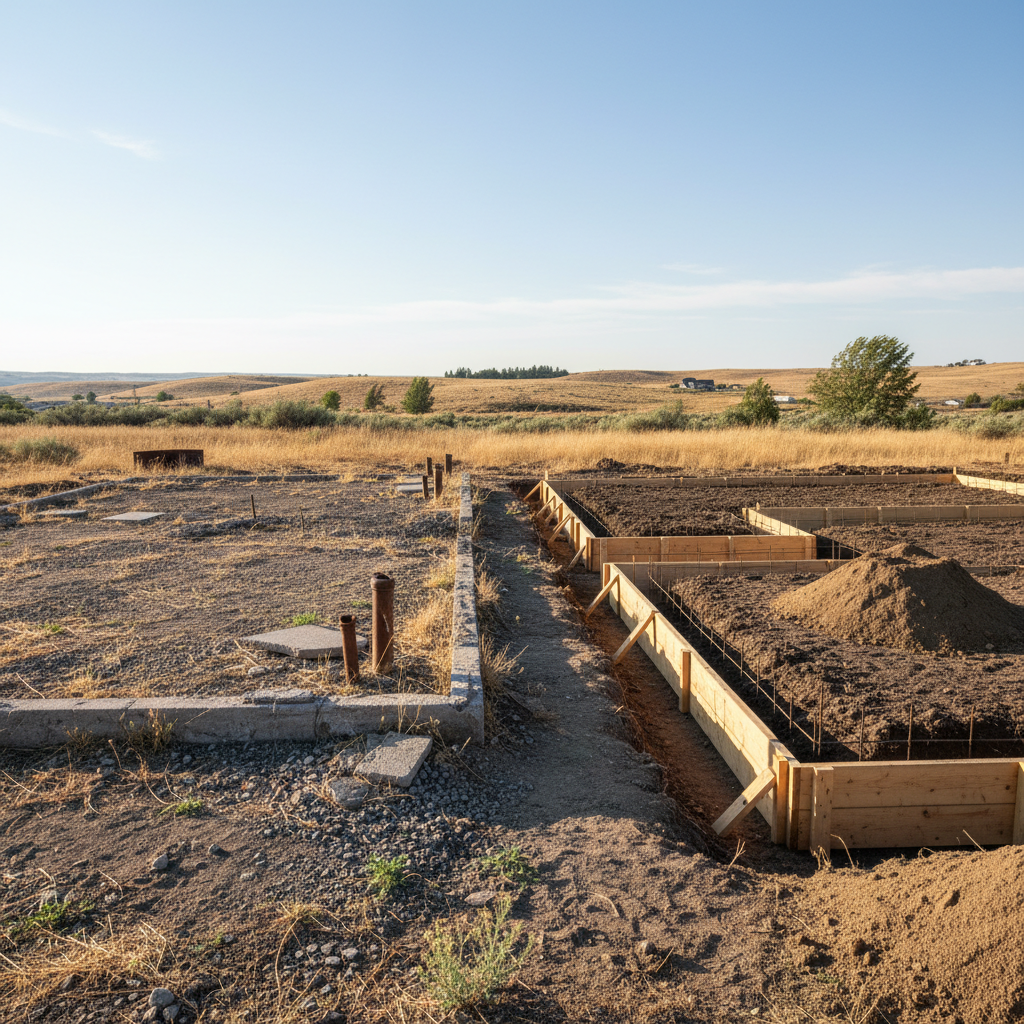
Deciding how to break ground for a new home or addition usually brings you to a major crossroad. Do you clear out the entire footprint with a mass excavation, or do you stick to a perimeter dig for just the exterior walls and footings? Moses Lake Excavating sees both methods used all across Grant County, and each one comes with distinct trade-offs depending on where your build is located.
We will break down how mass excavation and perimeter digging actually stack up against each other when you look at cost, durability, upkeep, and local soil realities.
The Real Cost Difference
Mass excavation means moving a massive volume of earth. Moses Lake Excavating brings in heavy machinery, strips the topsoil across the entire building pad, and digs out everything down to structural depth all at once. If you are planning a full basement or working on a sloped lot near Parker Horn, this is often the route you have to take. Up front, it costs more because of the sheer equipment hours and the truckloads of dirt we might need to haul off or stockpile.
Perimeter digging is leaner. We only trench out the exact lines where your foundation walls or footings will sit. Because we are moving less dirt, the initial equipment bill drops. But keep in mind that if you need to add utilities, install interior sub-slab plumbing, or deal with tricky grades later, you might end up doing extra manual digging that eats into those initial savings.
Handling Moses Lake Soil and Weather
Our local soil profile is heavy on sandy loam, mixed with occasional clay pockets and basalt shelves depending on whether you are up on the benches or down near the water. Sandy loam is generally forgiving to dig, but it loves to cave in if it dries out too fast or gets saturated during spring runoff.
With a mass excavation, we can completely stabilize the sub-grade, lay down engineered crushed rock, and achieve uniform compaction across the entire building footprint. That prevents uneven settling later. Perimeter digs leave the interior undisturbed, which is fine if your soils are consistent, but any uncompacted fill trapped inside those perimeter walls can settle and crack your slab down the road.
Durability, Maintenance, and Moisture Control
Water management is important in our climate. We see freezing winter freezes followed by blazing summer heat, which puts constant stress on concrete.
- Mass excavations make it much easier to install full drainage systems, perimeter drain tile, and proper sub-slab vapor barriers before any concrete goes down.
- Perimeter digs offer less room to maneuver for exterior waterproofing and proper backfilling, especially if the trench walls are tight against native soil.
- Maintenance costs favor whichever system was engineered right for the local water table. If you are building close to the lake or an irrigation canal where groundwater runs high, a poorly planned perimeter trench can turn into an accidental swimming pool during heavy irrigation seasons.
Which Approach Makes Sense Here?
If you want a crawlspace or a full daylight basement, mass excavation is not really optional—it is the only way to get the job done safely. For standard slab-on-grade construction on stable, flat sandy loam, a clean perimeter dig with precise footing trenches usually saves you money without sacrificing structural integrity.
Take a hard look at your blueprints, talk to your engineer about what is actually sitting underneath your topsoil, and make sure your excavation plan matches the realities of our local ground.